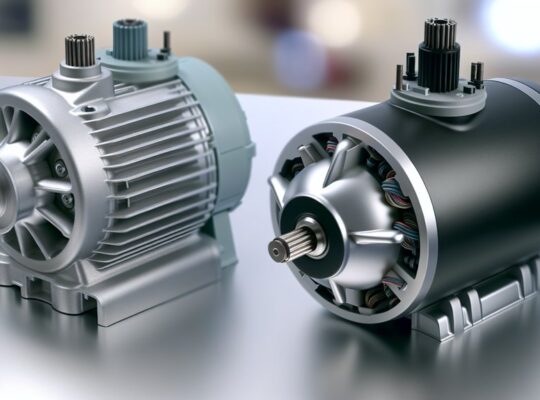
When you’re choosing motor windings, the copper-versus-aluminum trade-offs matter: copper gives higher conductivity and tighter thermal margins, while aluminum can cut weight and cost but demands larger cross-sections and special terminations. You’ll need to weigh thermal behavior, mechanical strength, and long-term resistive losses against manufacturing complexity and repairability. The optimal choice depends on duty cycle, space, and lifecycle costs—consider these factors before committing to a winding type.
Key Takeaways
- Copper offers ~60% higher electrical conductivity than aluminium, yielding lower I²R losses for the same cross-section.
- Aluminium requires about 1.6× the cross-sectional area of copper to match electrical conductivity and current-carrying capability.
- Copper’s higher thermal conductivity (~400 W/m·K) reduces hotspot risk and allows higher current density or smaller coils.
- Aluminium windings need careful joint design, anti-oxidation treatment, and specialized crimping/welding to avoid high contact resistance.
- Choose copper for high-duty, compact, or safety-critical motors; consider aluminium for cost- or weight-sensitive, lower-duty applications.
Electrical Conductivity and Performance Comparison
How do copper and aluminum windings actually compare when you’re sizing a motor for efficiency and thermal limits? You’ll find copper has about 60% higher electrical conductivity than aluminum, so for a given cross-sectional area copper yields lower resistive (I²R) losses. That means you can achieve higher efficiency or smaller conductor size using copper. Aluminum’s lower density reduces weight and cost, but you’ll need roughly 1.6 times the cross-sectional area to match copper’s conductivity, which affects slot fill and mechanical constraints. You’ll also account for contact resistance at terminations—aluminum demands more careful joint design and proper anti-oxidation treatment to maintain low resistance and safe operation. In performance-critical applications, copper minimizes voltage drop and heating for the same torque output. For safety-conscious designs, prioritize conductor sizing, reliable terminations, and protective protection settings to prevent overloads and ensure predictable, maintainable electrical performance. Philips models under ₹3000 often emphasize sturdy jars and stable motor performance, which matters when matching motor protection to winding choices.
Thermal Behavior and Heat Dissipation
When comparing winding types you’ll need to quantify how conductor thermal conductivity and cross-sectional geometry alter internal temperature gradients. Consider how insulation materials and their placement create distinct heat paths and thermal resistances from hot spots to the stator core and housing. Use thermal models and measured winding-to-case temperature rise to evaluate allowable continuous and short-duration loading. Kenstar mixer grinders’ reputation for durability and longevity demonstrates how appliance thermal design influences real-world performance.
Thermal Conductivity Differences
Because different winding materials and insulation systems conduct heat at markedly different rates, you must consider thermal conductivity when evaluating motor thermal behavior and heat dissipation. You’ll note copper’s thermal conductivity (~400 W/m·K) far exceeds aluminium’s (~237 W/m·K), so copper windings transfer Joule heat to adjacent structures more rapidly, reducing local hotspot intensity for a given current density. Conversely, aluminium’s lower conductivity raises thermal gradients, so you’ll need lower current density or improved cooling to maintain safe winding temperatures. When specifying windings, quantify allowable temperature rise, thermal time constants, and peak-to-average temperature differentials. Use these metrics to assess overload tolerance and protective settings. Prioritize conservative limits and verified thermal models to ensure operator and equipment safety. Also consider motor housing and cooling features such as advanced ventilation that affect heat dissipation and long-term reliability.
Insulation and Heat Paths
Insulation systems and their interfaces define the primary thermal pathways for motor windings, so you must evaluate their material properties, thicknesses, and contact resistances to predict heat flow and temperature distribution accurately. You’ll assess dielectric coatings, slot liners, varnishes, and mica tapes for thermal conductivity and maximum operating temperature, since these determine hot-spot gradients and allowable current density. Consider how impregnation and bonding reduce interface resistance, and how mechanical tolerances affect contact area between conductor, insulation, and core. Also factor in ventilation paths, cooling channels, and structural supports that provide convective and conductive heat escape routes. Prioritize materials and assembly methods that maintain thermal paths under mechanical and environmental stress to ensure operational safety and longevity. Evaluate motor designs for overload protection as a complementary safety measure that can prevent thermal damage during abnormal operating conditions.
Mechanical Strength and Durability
How do you assess the mechanical strength and durability of a motor winding assembly? You evaluate conductor tensile strength, fatigue resistance, and joint integrity under expected mechanical and thermal cycles. Quantify yield and ultimate strengths for copper and aluminium, including modulus of elasticity, and compare allowable stresses to in-service loads from vibration, torque transients, and electromagnetic forces. Inspect and test conductor-to-terminal joints for creep, fretting, and galvanic corrosion; use standardized pull and cyclic loading tests to verify retention factors.
Examine insulation system adhesion and abrasion resistance since conductor movement degrades dielectric layers; perform accelerated aging under combined thermal, mechanical, and humidity stress. Specify containment features—wedges, end turns bracing, and potting—validated by dynamic vibration and shock testing per industry standards. Define maintenance intervals based on measured wear rates and residual life predictions. Prioritize conservative safety margins, documented failure modes, and traceable test records to ensure reliable, durable operation in hazardous or mission-critical environments. Consider incorporating acoustic damping and insulated motor housings to reduce noise and vibration effects on long-term mechanical integrity.
Weight, Size, and Space Considerations
Why does weight and envelope matter so much for winding design? You assess payload limits, mounting constraints, and thermal management when choosing copper or aluminium windings. Weight affects dynamic loads, bearing life, and vibration transmission; envelope dictates cooling paths and clearance for insulation. You need precise mass and dimensional data to ensure structural integrity and safe operation.
- Reduced rotor/stator mass lowers inertial stresses during acceleration and emergency stops.
- Smaller envelope can constrain cooling airflow, raising conductor temperature margins.
- Heavier windings increase bearing preload requirements and influence alignment tolerances.
- Space-limited designs may force conductor shape changes, affecting current density and hot spots.
- Installation and maintenance access requirements set minimum clearances for safe handling.
You’ll quantify trade-offs with measured densities, thermal conductivities, and allowable current densities, then validate with FEA and safety-factored mechanical analysis before finalizing the winding choice. Overload protection mechanisms like thermal cutoff help prevent damage when elevated temperatures or currents occur.
Cost Analysis and Lifecycle Economics
What trade-offs will you accept between upfront material and manufacturing costs versus long-term operating and maintenance expenses? You’ll quantify total cost of ownership by combining initial procurement, expected efficiency-related energy consumption, scheduled maintenance, and end-of-life disposal or recycling. Copper’s higher conductivity reduces I2R losses, lowering operational energy costs and heat-related maintenance interventions; its higher purchase price and potential supply volatility increase initial capital outlay. Aluminium offers lower initial material cost and lighter mass, but higher resistive losses and more frequent thermal management inspections can raise lifecycle costs. You should apply net present value and payback-period analyses using realistic duty cycles, energy prices, and reliability failure rates. Include safety-related contingencies: derating margins, insulation replacement frequency, and costs for overheating mitigation. For safety-critical applications, prioritize lower failure probability even if upfront cost is higher. Document assumptions, sensitivity ranges, and maintenance labor rates so stakeholders can make defensible, safety-conscious procurement decisions. Higher-wattage motors like 750W models often justify copper windings due to tougher duty cycles and longer expected lifetimes.
Manufacturing Processes and Winding Techniques
Having quantified lifecycle costs and safety margins, you now need to examine how those economic and reliability choices shape manufacturing methods and winding techniques. You’ll assess process control, material handling, and quality assurance that differ for copper and aluminium—each demands specific tooling, thermal profiles, and insulation strategies to meet safety targets. Focus is on repeatability, contamination control, and minimizing mechanical stress during coil formation.
- Precision coil forming: mandrel design, tension control, and springback compensation for each conductor
- Insulation and impregnation: varnish type, drying cycles, and void mitigation to prevent partial discharge
- Jointing techniques: soldering, brazing, or mechanical joints with process validation and NDT
- Automated vs manual winding: cycle time, operator exposure, and process capability indices
- Thermal and vibration testing: in-line monitoring, acceptance criteria, and feedback to manufacturing parameters
You’ll prioritize validated processes, traceability, and conservative acceptance limits to ensure safe, reliable motor performance.
Repairability, Maintenance, and Rewinding
When assessing motor winding types you’ll want to consider how easily a coil can be rewound in the field versus at a workshop, since wire gauge, slot access, and insulation system directly affect labor and tooling requirements. You should evaluate long‑term maintenance implications—expected insulation life, susceptibility to thermal and mechanical stress, and diagnostic accessibility—for lifecycle cost projection. Finally, plan for rewind standardization and documentation so replacements restore original electrical and thermal characteristics with minimal trial and error. High-power domestic motors (typically 750 W motors) require attention to cooling and duty cycle when planning rewinds and maintenance.
Ease of Rewinding
How easily can a motor be rewound determines not just downtime but lifecycle cost, reliability, and maintenance strategy. You’ll find copper windings are more forgiving for rewind shops: they tolerate multiple reworks, soldered joints, and detailed turn-by-turn repairs with predictable electrical and thermal outcomes. Aluminium requires specialized crimping, welding, or mechanical terminations and you’ll need tools and fixtures to avoid cold joints and high-resistance connections. Safety-wise, both demand insulation integrity verification and surge/polarity testing post-rewind.
- Copper allows conventional coil extraction and re-lamination with standard tooling.
- Aluminium needs oxidative protection and controlled pressure terminations.
- Rewinding time typically shorter for copper in skilled shops.
- Skill level and equipment up-front determine successful aluminium repairs.
- Test protocols are identical: hipot, insulation resistance, and surge tests.
Panasonic models with copper winded motors are therefore often easier and quicker to service for domestic mixer grinders.
Long‑Term Maintenance
Beyond immediate rewindability, long-term maintenance demands a systems-level view of repairability, parts availability, and predictable degradation modes. You’ll assess winding material selection by lifecycle risk: copper resists creep and thermal fatigue, aluminium requires monitoring for joint corrosion and relaxation. Plan scheduled inspections, vibration analysis, and insulation testing; keep certified spares and documented torque/spec procedures to preserve safety margins. Rewinding protocols must specify conductor preparation, joint design, and varnish cure profiles to avoid hotspots. For rotating machines, also incorporate overload protection checks into routine maintenance to prevent motor failures.
| Attribute | Copper | Aluminium |
|---|---|---|
| Degradation mode | Thermal fatigue | Joint loosening/corrosion |
| Service implication | Fewer rewinds | More frequent joint checks |
| Safety action | Standardized torque | Enhanced bonding/inspection |
Typical Applications and Industry Use Cases
Motors with different winding types are chosen based on torque, speed, thermal, and duty-cycle requirements you face in an application; for example, lap-wound DC motors excel in high-current, low-speed traction tasks, while wave-wound machines favor higher-voltage, continuous-duty generators. You’ll select copper windings where conductivity, thermal margin, and compactness are essential (e.g., aerospace actuators, precision robotics). Aluminium is chosen when cost, weight, and acceptable conductivity trade-offs matter (e.g., large HVAC fans, mine ventilation). For safety-critical systems you’ll prioritize thermal monitoring, proper insulation class, and strict maintenance intervals regardless of conductor.
- Heavy industry: crane hoists, mine drives — copper for duty cycles with high thermal stress
- Transport: traction motors — copper lap windings for high torque
- Renewable generation: alternators — wave windings for continuous output
- HVAC and pumps: aluminium for cost/weight optimized large motors
- Hazardous locations: copper with intrinsic safety measures and enhanced insulation
Specify testing protocols, temperature limits, and replacement criteria to maintain safe operation.
Frequently Asked Questions
Are There Magnetic Property Differences Between Copper and Aluminium Windings?
No, they don’t differ magnetically; both are nonmagnetic conductors, so magnetic properties are negligible. You’ll need to account for conductivity and resistive heating differences, which affect performance and safety, not intrinsic magnetic behavior.
How Do Copper and Aluminium Affect Motor Noise and Vibration?
Copper generally reduces electrical losses and heating, so you’ll get slightly lower electromagnetic noise and vibration; aluminium’s higher resistivity and lower density can increase heating and structural vibration, so you’ll need firmer mounting and thermal safeguards.
Do Environmental Regulations Favor One Conductor Over the Other?
Generally, regulations don’t explicitly favor one conductor; you’ll need to comply with material-specific rules (recycling, RoHS, conflict minerals). You’re required to evaluate lifecycle impacts, recyclability, and reporting obligations when selecting copper or aluminium.
Can Aluminium-To-Copper Transitions Cause Galvanic Corrosion Inside Motors?
Yes — aluminium-to-copper transitions can cause galvanic corrosion if dissimilar metals contact with an electrolyte. You’ll need proper isolation, compatible connectors, protective coatings, and controlled environments to prevent accelerated degradation and ensure safe, reliable motor operation.
Are There Differences in Recyclability and End-Of-Life Processing?
Yes — you’ll face different recycling streams and separation challenges: copper’s higher value and purity simplify recovery, while aluminium requires different processing and careful handling of mixed metals, insulating materials, and potential contaminants to ensure safe, compliant disposal.