You’ll use a mixer grinder every day, often while managing other tasks, so its noise becomes a constant factor in your home. High sound levels cause fatigue, disrupt conversations, and raise safety risks when you can’t hear timers or alarms. Noise is quantifiable and reducible through design choices, so knowing what to look for helps you pick a unit that meets both power and acoustic needs — here’s how to evaluate those trade-offs.
Key Takeaways
- High noise increases auditory fatigue and stress, making long or frequent meal prep uncomfortable and unsafe.
- Loud grinders impair verbal communication and awareness, raising risk during multitasking in shared homes.
- dB(A) ratings (Leq/Lmax) let you compare real-world exposure; lower Leq is most relevant for sustained use.
- Quiet engineering (insulated housings, balanced rotors, damping) reduces peak sounds and mechanical vibration.
- Balancing sufficient motor torque and thermal design with low RPM operation yields durability without excessive noise.
Why Loudness Affects Daily Kitchen Life
How much noise can you tolerate in the kitchen when you’re preparing meals every day? You need to consider auditory fatigue, communication interference, and concentration loss caused by prolonged exposure to high sound levels from a mixer grinder. Excessive loudness can raise stress hormones, increase reaction times, and impair your ability to hear warnings such as timers or gas burner clicks. In shared housing, loud operation disrupts others’ activities and sleep cycles, creating safety hazards. Selecting a quieter unit reduces cumulative exposure and supports clearer verbal exchange during multitasking, lowering accident risk. Prioritize models that minimize peak sound events and contain mechanical vibration; doing so enhances situational awareness and reduces the likelihood of injury or equipment misuse. Many modern silent mixer grinders feature low noise operation as a key selling point, improving daily kitchen comfort and safety.
How Noise Is Measured and Reported
Because you’ve just considered the real-world impacts of loudness, it’s useful to understand how manufacturers and testers quantify noise so you can compare models objectively. Noise is measured in decibels (dB) using A-weighting (dB(A)) to approximate human hearing sensitivity; look for dB(A) values for consistency. Test protocols specify distance (commonly 1 m) and operating condition (idle, grind with standard load), so confirm test setup before comparing numbers. Measurements use calibrated sound level meters conforming to IEC 61672 or ANSI S1.4; check for stated standard. Some labels report peak and equivalent continuous sound level (Lmax and Leq); Leq is most relevant for exposure and safety. Also note measurement uncertainty and environmental conditions, since they affect reproducibility. For practical decision-making, consider the noise performance of comparable appliances like the 750-watt motor models mentioned in mixer grinder reviews.
Engineering Features That Lower Sound Levels
Which components make a mixer grinder quieter without sacrificing performance? You should evaluate specific engineering elements: insulated motor housings that use dense, fire-retardant composites reduce airborne noise while meeting thermal safety. Precision-balanced rotors and low-vibration shafts minimize mechanical excitation to bearings. Use of acoustic damping liners and segmented baffle chambers attenuates broadband and tonal emissions without restricting airflow. High-quality sealed bearings with appropriate lubrication lower frictional noise and contamination risk. Tight-tolerance gear trains or direct-drive couplings eliminate rattles and gear mesh noise. Electromagnetic noise is reduced by well-wound stators and skewed rotor slots that lower cogging torque. Finally, compliant mounting feet isolate structure-borne vibration from countertops. Many modern consumer models also combine these features with stainless steel jars for durability and hygiene.
Balancing Power, Durability, and Quiet Operation
Having low acoustic emissions is only one part of the design equation; you also need power and robustness that don’t get sacrificed for quiet operation. When assessing mixer grinders, evaluate motor power density and thermal management: higher torque at lower RPM reduces noise while maintaining performance, provided cooling prevents overheating. Inspect bearing quality and shaft alignment; precision bearings and tight tolerances minimize vibration-induced noise and wear. Look for reinforced housings and damping mounts that extend service life without adding resonance. Confirm ingress protection and electrical safety ratings to ensure durable operation under load. Review duty cycle specifications and warranty terms to verify the unit can sustain intended use. Prioritize models with documented test data so you can balance quietness with reliable, safe performance. Consider warranty coverage such as 5 years on the motor when weighing long-term reliability against noise and performance.
Practical Tips for Reducing Grinder Noise at Home
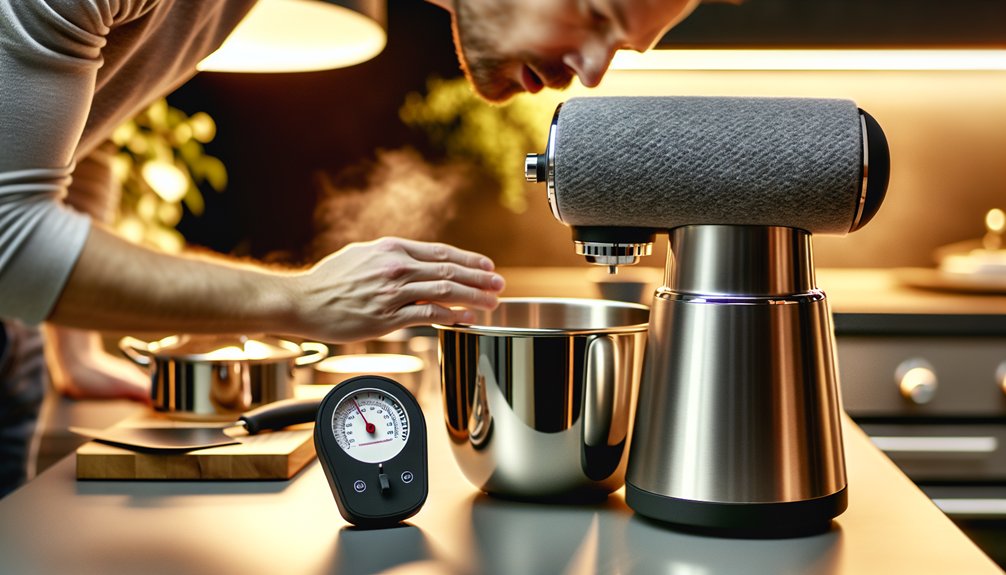
Want quieter grinding without sacrificing performance? Implement controlled interventions that reduce airborne and structure-borne noise while maintaining safety. First, isolate the unit: place the grinder on a dense anti-vibration mat and ensure feet are level to minimize resonance. Second, maintain mechanical integrity: tighten loose fasteners, inspect and replace worn bearings, and use manufacturer-approved blades to prevent imbalance. Third, optimize operating conditions: grind in shorter intervals to avoid motor overheating, select lower speed settings for softer ingredients, and position the appliance away from hard surfaces and glass to reduce reflections. Follow electrical safety: unplug before maintenance, allow components to cool, and use gloves for blade handling. Choose a model with overload protection to further protect the motor and reduce noise from stress-related vibrations.
Frequently Asked Questions
Do Quieter Grinders Cost Significantly More to Maintain Long-Term?
Generally no, quieter grinders don’t cost substantially more to maintain long-term; you’ll pay slightly higher parts or specialized damping replacements, but routine servicing, motor care, and safety checks remain comparable in frequency and expense.
Can Noise Levels Affect Food Oxidation or Flavor?
Yes — noise itself doesn’t cause oxidation or flavor change; however, higher-speed, poorly damped motors that produce more noise can generate heat and agitation, which’ll accelerate oxidation and alter volatile flavor compounds, affecting safety-sensitive foods.
Are There Health Standards for Appliance Noise Exposure?
Yes — occupational standards (NIOSH, OSHA) set exposure limits (85 dB(A) over 8 hours, exchange rate 3 dB). Consumer appliance guidance is less strict, so you should minimize prolonged close noise exposure for safety.
Do Warranties Cover Noise-Related Defects or Motor Hums?
Yes — warranties can cover noise-related defects or abnormal motor hums if they’re due to manufacturing faults; you’ll need to document symptoms, provide diagnostics or service reports, and comply with warranty terms, exclusions, and authorized repair procedures.
Is Noise Level Affected by Blade Type or Jar Material?
Yes — blade geometry and sharpness influence aeration and vibration, and jar material (stainless steel, glass, plastic) alters resonance and damping. You’ll get different noise spectra; choose combinations minimizing vibration and ensuring safe mounts.